

Short-form video has become one of the most accessible ways for creators, marketers, and small businesses to reach an audience. But there is one problem that keeps many people from getting started: they don’t want to be on camera.
That is where Faceless Reels come in.
Instead of filming yourself talking to a camera, faceless content uses narration, captions, screen recordings, stock footage, animations, product demonstrations, or AI-generated visuals to communicate an idea. The creator can stay completely off-camera while still producing content for Instagram Reels, TikTok, and YouTube Shorts.
More importantly, faceless content is not simply a way to avoid appearing on screen. It can become a repeatable content production system.
What Are Faceless Reels?
A faceless Reel is a short-form vertical video where the creator does not appear on camera.
The format can take many forms:
- Educational tips with animated text
- Narrated stories with supporting visuals
- Product demonstrations
- Screen-recorded tutorials
- List and ranking videos
- Motivational content
- Interesting facts and historical stories
- AI-generated visual storytelling
- Before-and-after demonstrations
- Tutorials and how-to content
The common element is that the content itself becomes the personality of the account, rather than the person behind the account.
This makes faceless videos particularly interesting for people who want to build an audience without turning their personal identity into their brand.
Why Are More Creators Going Faceless?
The biggest advantage of faceless content is simple: you remove the camera from the production process.
A traditional talking-head video might require a camera, lighting, microphone, background, makeup, multiple takes, and editing. Even a relatively simple video can become a surprisingly time-consuming production.
With a faceless workflow, the production process can be much simpler:
Idea → Hook → Script → Voice → Visuals → Captions → Publish
This also makes it easier to batch-produce content.
Instead of spending an entire afternoon recording one video, a creator can develop several ideas, turn them into short scripts, and produce multiple videos in a single session.
That consistency can be more valuable than trying to make every individual video perfect.
The Most Useful Faceless Reel Formats
Not every niche requires the same video format. Some formats, however, are particularly well suited to faceless content.
1. Educational Videos
Educational content is one of the easiest formats to adapt to a faceless workflow.
For example:
“3 things you should know before buying your first mechanical keyboard.”
The video can combine narration, product footage, screenshots, diagrams, and animated captions without ever showing the creator.
This works particularly well for technology, finance, productivity, marketing, history, fitness, and other information-driven niches.
2. Storytelling
Stories naturally lend themselves to voiceover and supporting visuals.
A creator can tell the story of an unusual historical event, an interesting business failure, or a strange scientific discovery while using AI-generated scenes, stock footage, maps, and text overlays.
The viewer doesn’t necessarily need to see the person telling the story. They need a reason to keep watching.
3. Product Content
Faceless videos can also be useful for businesses.
A product can be demonstrated through close-up footage, screen recordings, animations, or simple visual explanations.
For SaaS companies, for example, a screen recording can show a feature while a voiceover explains the problem it solves.
This allows a company to create short-form marketing content without putting the founder or employees on camera.
4. List Videos
List-based formats are another natural fit.
Examples include:
- 5 AI tools worth trying
- 7 productivity mistakes
- 3 websites you probably don’t know
- 5 useful Chrome extensions
- 10 interesting facts about space
The structure is straightforward, which makes it easier to turn the format into a repeatable production template.
The Most Important Part Is Still the Hook
Using AI does not automatically make a video interesting.
One of the biggest mistakes new faceless creators make is focusing too much on production quality and not enough on the first few seconds.
A better workflow starts with the idea and the hook.
Instead of:
“Today we’re going to talk about productivity.”
Try something more specific:
“This productivity trick saves me almost an hour every day.”
The second version creates an immediate reason to continue watching.
A useful faceless video structure is:
Hook → Problem → Information → Payoff → Call to Action
The visuals then support the story rather than becoming the story themselves.
AI Is Changing the Faceless Video Workflow
Traditionally, producing a faceless video still required several different tools.
You might need one application for writing the script, another for generating voiceover, another for finding footage, another for editing, and another for adding captions.
AI is gradually bringing these steps together.
Modern AI video workflows can start with a simple idea and generate a large portion of the production process automatically: the script, scenes, voice, visuals, captions, music, and final edit.
This changes the economics of short-form content.
The goal is no longer necessarily to spend hours producing one polished video. Instead, creators can build a repeatable system for testing many ideas.
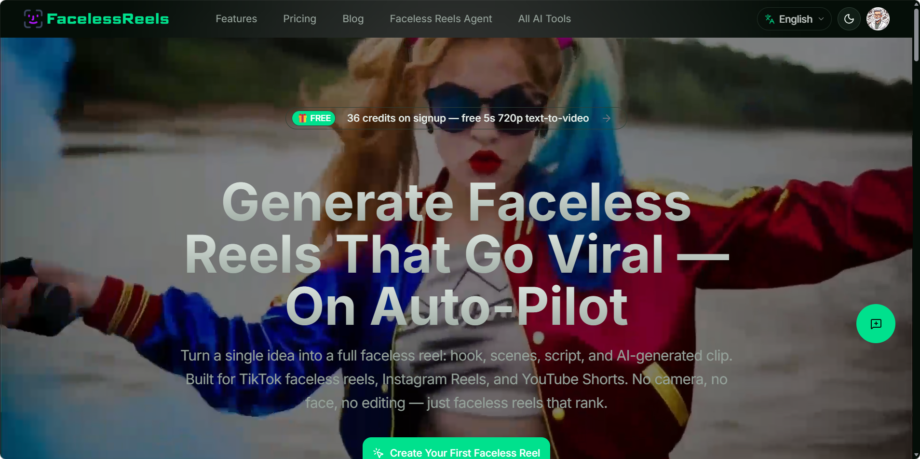
Tools such as FacelessReels are designed around this workflow, turning an idea into a complete faceless short video rather than requiring creators to manually assemble every component.
One Idea Can Become Three Pieces of Content
Another advantage of faceless content is repurposing.
Suppose you create a 30-second educational video about an AI tool.
The same underlying idea can become:
- An Instagram Reel
- A TikTok
- A YouTube Short
You may need to adjust the title, captions, pacing, or call to action for each platform, but the core concept remains the same.
This means creators don’t necessarily need three separate content strategies.
They can build one content pipeline and adapt it for multiple platforms.
Don’t Confuse Automation With Spam
There is an important distinction between producing content efficiently and producing low-quality content at scale.
AI can make it easier to generate dozens of videos. That does not mean every generated video deserves to be published.
Creators should still review:
- Whether the information is accurate
- Whether the visuals match the script
- Whether the narration sounds natural
- Whether captions are readable
- Whether copyrighted material is being used appropriately
- Whether the content provides something useful to viewers
The objective should be to use AI to remove repetitive production work, not to remove human judgment.
A Simple Faceless Content Workflow
For someone starting from zero, the process can be surprisingly simple.
Step 1: Choose One Niche
Don’t start by trying to create videos about everything.
Choose a specific subject that you can produce content about repeatedly.
Step 2: Build an Idea Bank
Collect questions, interesting facts, common problems, product ideas, and topics people already care about.
Your idea bank becomes the foundation of your content pipeline.
Step 3: Write Hook-First Scripts
Start with the most interesting part of the idea.
The first sentence should tell the viewer why the video is worth watching.
Step 4: Match Visuals to the Story
Every scene should have a purpose.
Avoid adding random stock footage simply because the screen needs something to display.
Step 5: Generate and Edit
AI tools can now handle much of the repetitive work involved in creating voiceovers, visuals, captions, music, and editing.
Step 6: Review Before Publishing
Always watch the finished video from beginning to end.
Fix incorrect information, awkward narration, visual inconsistencies, and captions before publishing.
Step 7: Repurpose
Turn successful concepts into variations and distribute them across Instagram Reels, TikTok, and YouTube Shorts.
The Real Advantage of Faceless Content
The biggest advantage of faceless content isn’t that you never have to show your face.
It is that content production becomes more repeatable.
A creator can develop a recognizable visual style without appearing personally in every video. A business can publish educational content without asking its founder to record a new video every day. A small marketing team can experiment with multiple content ideas without building a full production studio.
That makes faceless video more than a trend. It is becoming a practical content format for creators and businesses that value privacy, consistency, and production efficiency.
The technology will continue to change, but the fundamentals remain the same: find an interesting idea, create a strong hook, deliver useful information, and give people a reason to keep watching.
And when the production process becomes easier, creators can spend less time worrying about cameras and editing timelines—and more time thinking about what their audience actually wants to watch.
[Youtube]
[Gravatar]